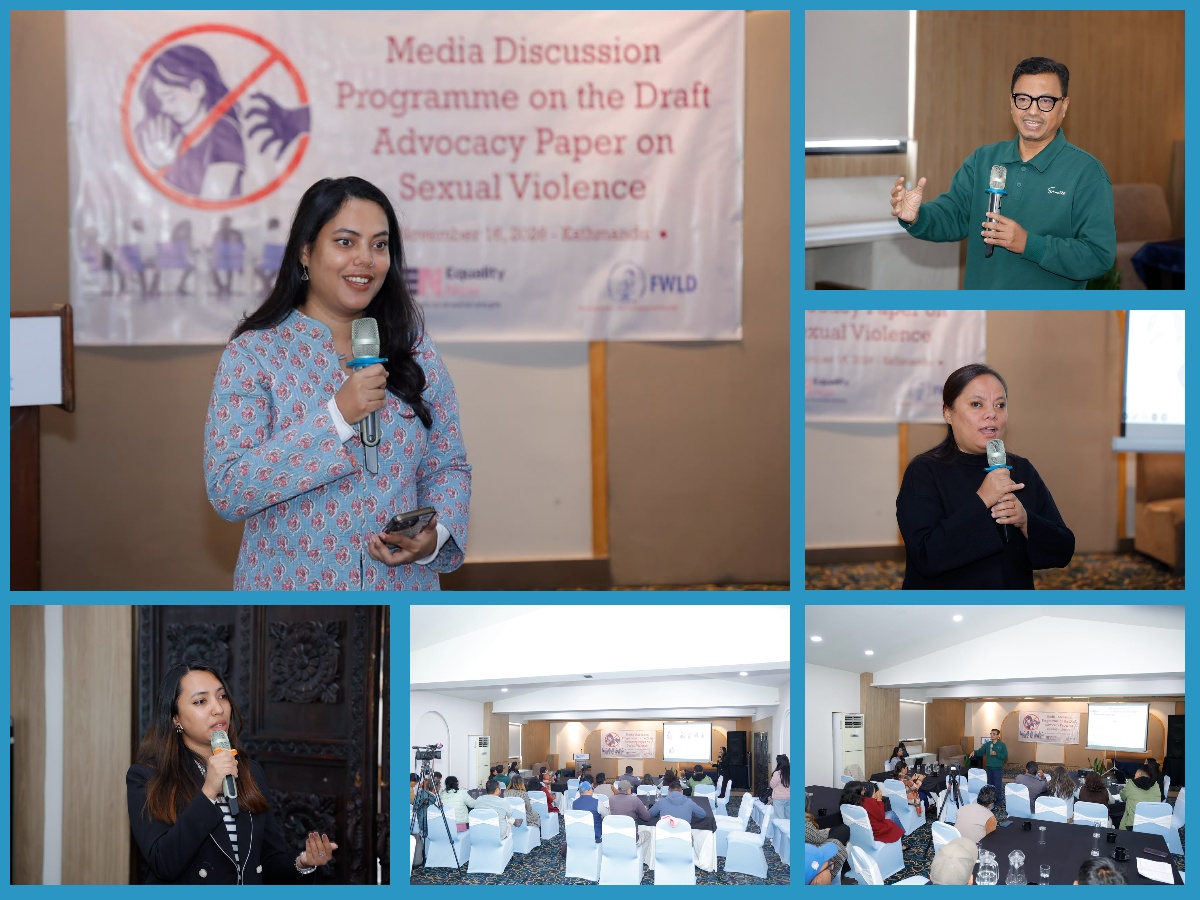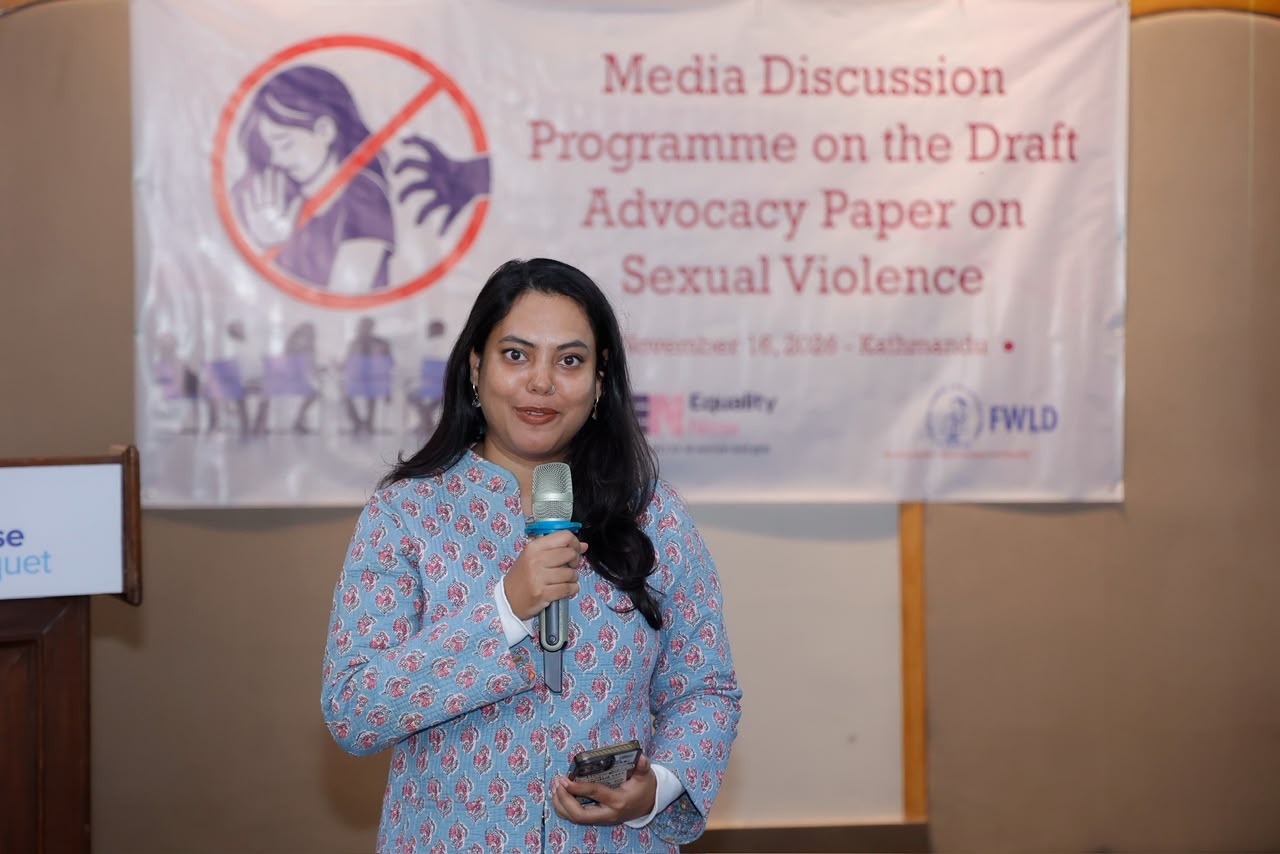

Kathmandu: The proposed bill on sexual violence drafted by the Ministry of Law, Justice and Parliamentary Affairs requires further improvements, stakeholders have pointed out. During an interaction with media professionals jointly organized by the Forum for Women, Law and Development (FWLD) and Equality Now on Monday, recommendations were presented, highlighting shortcomings in various provisions of the proposed legislation.
Presenting an advocacy paper on sexual violence, FWLD advocate Didriksha Singh said that five major areas of the proposed bill need revision. These include the definition of rape, the definition of consent, the close-in-age exemption, marital rape and the statute of limitations.
The bill drafted by the Ministry of Law, Justice and Parliamentary Affairs proposes recognising non-consensual sexual acts involving or between people from sexual and gender minority communities as rape. However, the advocacy paper recommends revising the provision in line with the United Nations Model Rape Law (UN Model Rape Law).
It states that equal legal protection should be guaranteed to all individuals without discrimination based on sex or gender identity. Any non-consensual sexual penetration, to any extent, of the vagina, anus or mouth using any body part or object should be defined as a criminal offence.
Similarly, the paper recommends defining consent as an explicit agreement given voluntarily and through free will. It also calls for clear legal provisions stating that consent cannot be presumed based on a victim’s silence, failure to resist, past sexual history, profession or relationship with the accused.
The paper further recommends revising the phrase “not in a state of consciousness” in Section 219 (2) (b) of the proposed bill to explicitly include circumstances in which a person is unable to give consent due to unconsciousness, sleep, or the consumption of alcohol or drugs.
The proposed provision concerning consensual sexual relations between adolescents below the age of 18 also requires revision, according to the advocacy paper. The bill proposes imprisonment of up to one year for consensual sexual relations between adolescents whose age difference is two years or less.
Instead, the paper recommends completely exempting consensual sexual relations between adolescents from criminal liability if both individuals are at least 14 years old and the age difference between them does not exceed two years. However, cases involving fear, threats, inducement, exploitation, or abuse of power or authority should not fall under this exemption and should remain subject to strict penalties.
The provisions concerning marital rape also need to be amended. The proposed bill provides for imprisonment of three to five years if a husband commits rape against his wife while the marital relationship remains intact. However, the advocacy paper recommends applying the same legal definition and penalties for marital rape as for other forms of rape, regardless of marital status.
Likewise, the paper recommends completely abolishing the statute of limitations for rape cases to ensure survivors’ access to justice and prevent perpetrators from escaping legal accountability.
Speaking about the purpose of the programme, Akanksha Saxena, South Asia Regional Communications Officer at Equality Now, said Nepal’s commitment to developing legislation against sexual violence was encouraging. However, she emphasised that effective implementation of the law was equally important.
The programme also presented statistics on the prevalence of sexual violence in Nepal and around the world. Highlighting that a large number of survivors of sexual violence do not come forward to file complaints, FWLD Executive Director and advocate Sabin Shrestha said that amending all five areas highlighted in the proposed bill would help create a more supportive environment for survivors to report cases.
FWLD advocate Binu Lama also stressed the need to completely abolish the statute of limitations for rape-related offences to ensure survivors’ access to justice.